Sandboxes are devices containing simulations of sand that evolve into virtually endless patterns, respond to your touch (or here, the drag of your mouse), and may be networked to create a worldwide playspace for abstract communication. See site for much more.
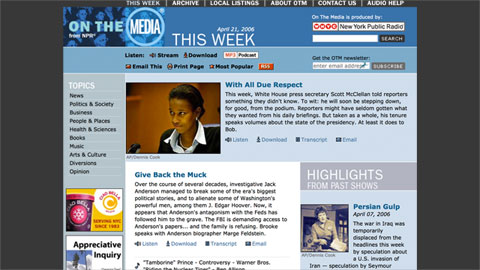
I was asked to redesign and build this major overhaul of WNYC/NPR's On The Media website. I created fully standards- compliant table-free templates and art directed the design. Click the links above to see the templates I delivered, or visit onthemedia.org here.
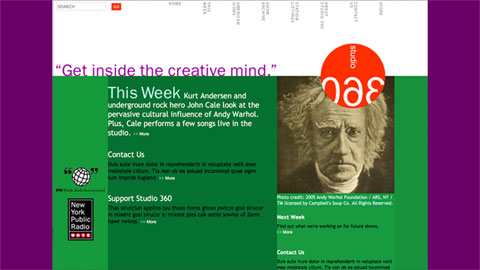
I was asked to build this major overhaul of WNYC/NPR's Studio 360 website. I created a fully standards- compliant table-free XHTML / CSS / Javascript templates. Click the links above to see the work I delivered, or visit studio360.org here.
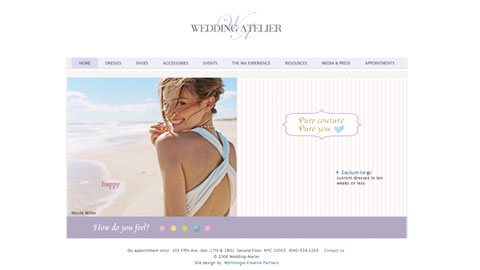
I created the XHTML, CSS, and Javascript for Wedding Atelier, using a fully standards-compliant table-free design and DOM scripting for interactivity. Click the links above to see the templates I delivered, or visit Wedding Atelier here.
I created the XHTML, CSS, and Javascript for the Coolhunting Gift Guide, using an accessible standards- compliant design. Click the links above to see the templates I delivered, or visit the Coolhunting Gift Guide here.
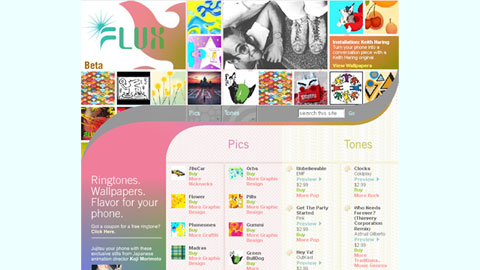
I created standards-compliant table-free XHTML and CSS templates for flux.com, to accomplish a truly challenging design. The site no longer exists, but you may click the links above to view screenshots, or see a rather mangled archive of flux.com here.
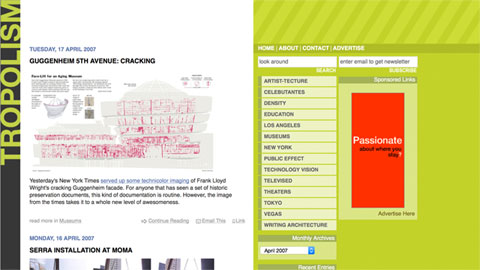
I created the XHTML, CSS, and Javascript templates for tropolism.com, using a standards-compliant table-free design, and integrated them into the Moveable Type content management system. Click the links above to see the work I delivered, or visit tropolism.com here.
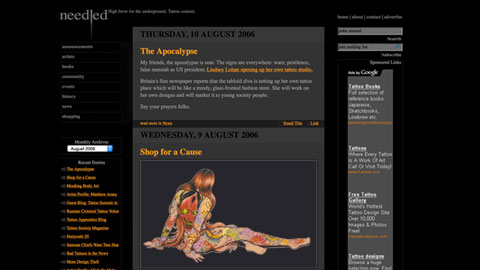
I created the XHTML, CSS, and Javascript teamplates for needled.com, using a standards-compliant table-free design, and integrated them into Moveable Type. Click the links above to see the work I delivered, or open the archived version of needled.com here.
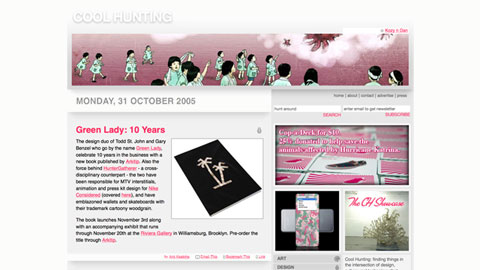
I created the XHTML, CSS, and Javascript templates for coolhunting.com, using a standards-compliant table-free design, and integrated them into Movable Type. Click the links above to see the work I delivered, or visit an archive of coolhunting.com here.
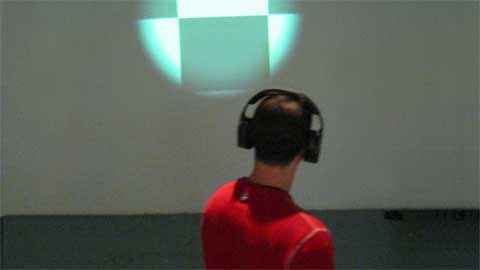
Flow was an interactive audio-visual installation created with Chiaki Watanabe. A software-sensor system processed audio and video to respond to a participant's movement within a circle on the floor. Flow explored emotion and the path we chart through life.
Video interpretations of tweleve human emotions were projected on a wall while corresponding audio interpretations were transmitted to participants via wireless headphones. A software-sensor system subtly modified the interpretations based on parameters affected by each participant. Flow was exhibited at the VertexList gallery in New York City.
Sandboxes are devices containing simulations of sand that evolve into virtually endless patterns, respond to your touch (or here, the drag of your mouse), and may be networked to create a worldwide playspace for abstract communication. See site for much more.
The shifting sand evokes broad concepts of life and loss, equilibrium, impermanence, and nostalgia. Interacting with a Sandbox, and with others across the Sandbox Network, is intended to inspire tranquility, abstract thought, and subtle happiness.
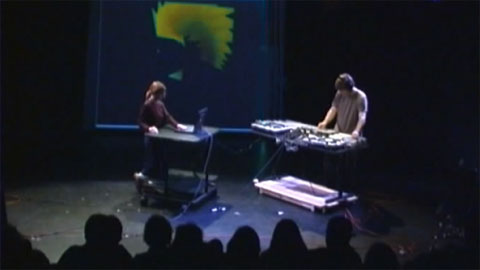
Sandboxes AVC was a collaborative performance illustrating future goals of the Sandboxes -- a shared audio-visual playspace. Teresa Almeida synthesized video using a custom version of my Gesture Painter software, while I created an analog audio soundscape.
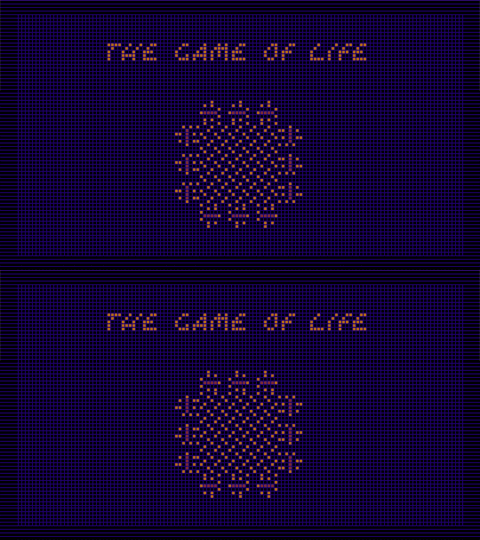
My version of Conway's Game of Life is like many others, except for its ability to seed the cells with over 100 patterns that result in fascinating behaviors. You may also modify these patterns or create your own. See the site for more info and instructions.
The "Game of Life" is a visual manifestation of an algorithm developed by the mathematician James Conway in 1970. It is not a game in the traditional sense. It is a demonstration that the application of simple rules may inspire incredible complexity.
My version of the Game of Life is like many others, except for its ability to seed the cells with over 100 patterns that result in fascinating behaviors. You may also modify these patterns or create your own.
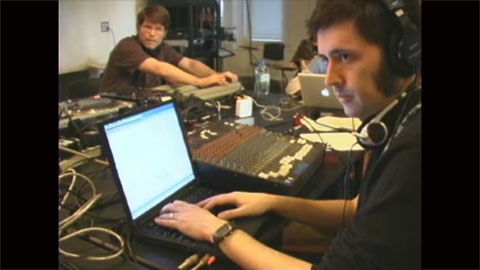
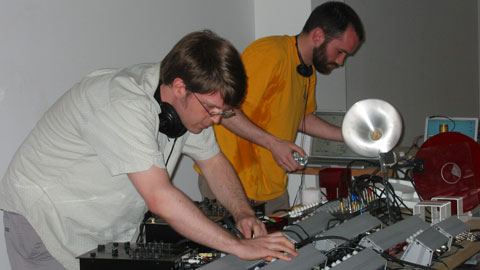
Son(net) Subterfuge was a live video, audio, and dance performance networked among artists in New York, Amsterdam, and Helsinki. I directed the New York crew and performed analog audio and signal processing. See the Son(net) Subterfuge site for more info.
At the basis of the project was an invitation to remix a selection of Shakespeare sonnets as a live sound or video piece. These performances were streamed to the de Waag Society in Amsterdam, where they were mixed and projected to provide the accompanying audio and video for a dance performance. Video of this collective performance was streamed back to New York, fulfilling a feedback cycle of interpretive give and take. I organized the 9-member New York crew, and contributed improvised analog electronic audio textures. Concept and direction by Josephine Dorado from de Waag.
The Gesture Painter is a digital painting tool. It visualizes the gesture of your mouse. You may use to synthesize video and create spontaneous animations. It is highly customizeable via the keyboard. See the Gesture Painter site for more info and instructions.
The Sand Clock is an interactive representation of time. A grain of sand appears each second that passes in a day, until midnight, when the cycle begins anew. The sand evolves over time, and disperses softly beneath your finger. See the Sand Clock site for much more.
At its most fundamental level, the intricate motion, pleasant responsiveness, and luminous color are designed to fascinate. Discerning deeper, the metaphor of shifting sand recalls broad concepts of time and timelessness, life and loss, equilibrium, and nostalgia. Their persistent evolution reminds us of the fluidity of the present moment, the impermanence of human touch, and the power of nature to reclaim.
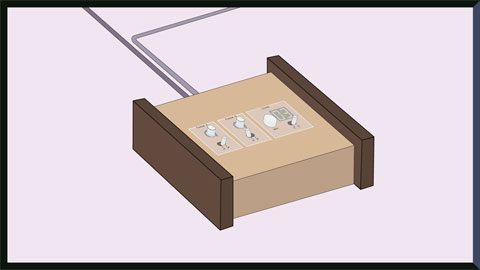
The Sound Canvas is an analog electronic MIDI controller. Touch screens provide simultaneous random access to multiple paramaters, which are translated by a microchip into MIDI control data. See the site for more info.
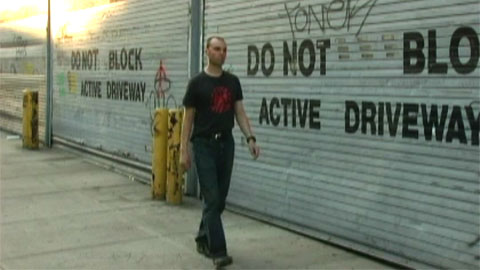
The Sound Canvas is actually two canvases, each a 6 by 9 inch glass touch screen. Each touch screen provides simultaneous random access to two parameters, defined by the x and y coordinates of the musician's touch. A microchip interprets these coordinates, translates them into MIDI data, and sends them to any MIDI-controllable external instruments. The mapping of the coordinates may be set by switches, and the ranges of the parameters may be fine-tuned with knobs. Careful thought was put into function and providing features not currently available with pre-existing instruments. I performed the Sound Canvas live at Tonic, in New York City.
Sleepless is a minimally produced composition of sounds I performed using the first version of the Sound Canvas electronic music interface. Sleepless was performed, recorded, and produced the afternoon of December 6, 2002, after a night without sleep. For best results use good headphones able to re-create very low frequency audio.
Living Presence is a series of lovingly crafted hand printed black and white photography spanning eight years in Philadelphia, New York, and travels in the US and Europe. They are distinctly representational while strongly abstract. See site for much more.
2008 Brian Maniere